Road To Your Name - Season 8, Episode 3: A conversation with Dr. Jean Dryden about copyright
Who Owns the Story? Copyright, Indigenous Knowledge, and AI with Dr. Jean Dryden
Road to Your Name | Season 8, Episode 3
This episode was recorded in November 2025.
This episode was recorded in November 2025.
Episode Description
Copyright affects every creator — and yet most people, Indigenous or not, don’t fully understand how it works or when it protects them. In this episode, Lisa sits down with Dr. Jean Dryden, an internationally recognized expert on copyright and archival material, for a wide-ranging conversation that starts with the basics and leads somewhere unexpected: the deep resonance between Indigenous communal knowledge and the unresolved questions AI is forcing copyright law to reckon with.
Dr. Dryden has spent more than 25 years working at the intersection of copyright law, libraries, and archives. She holds a Master of Laws degree specializing in intellectual property from Osgoode Hall Law School, has taught at the University of Toronto and the University of Maryland, and has represented the International Council on Archives at the World Intellectual Property Organization in Geneva. She is the author of Demystifying Copyright: A Researcher’s Guide to Copyright in Canadian Libraries and Archives.
The conversation covers how Canadian copyright law works, what it gets right and wrong for Indigenous creators, the gap between how copyright treats authorship and how Indigenous nations hold communal knowledge, and why AI is forcing everyone — lawyers, legislators, and creators alike — to grapple with questions that don’t yet have answers.
What We Talk About
- What copyright is — and why Dr. Dryden calls it “an ingenious but imperfect system” trying to balance creators’ rights against the public’s right to access and build on existing works
- A brief history of Canada’s Copyright Act, which dates to 1921 and has evolved through multiple amendments to keep pace with new technologies
- How social media changed the copyright landscape — and why Canada’s “user-generated content provision” (2012) was a practical response to the reality that policing every mashup and remix is impossible
- The three open copyright questions AI has created: whether AI-generated works are even protected by copyright, whether rights holders should be compensated for their work being used to train large language models, and who bears liability if infringement occurs
- Why courts — especially in the US — will likely shape copyright and AI policy before legislators do, and what Canada might learn from watching those cases unfold
- The brilliant connection Lisa makes: AI’s challenge to individual authorship parallels the challenge Indigenous communal knowledge has always posed to copyright law
- Why Canadian copyright law doesn’t accommodate communal ownership — and why the 70-year post-death expiry rule means most traditional stories and songs are technically in the public domain, even though Indigenous nations don’t see it that way
- Dr. Dryden’s argument that a separate, stand-alone law for Indigenous traditional knowledge — rather than trying to fit it into the existing Copyright Act — would be the better path forward
- Why such a law would need to account for more than economic value, including cultural and spiritual values, and different levels of access within communities
- What happens when an individual (Indigenous or non-Indigenous) asserts copyright over a traditional story or song — and the factors that determine whether anything comes of it
- Music sampling, industry guidelines, and how copyright enforcement evolves when monitoring every use is impractical
- How to protect your own creative work: copyright exists the moment a work is created, but registering with the Canadian Intellectual Property Office (~$65) gives you a legal head start if challenged
- Why marking your work with the copyright symbol, your name, and the year is one of the simplest things any creator can do
- The “mailed envelope” trick — and why Dr. Dryden considers it copyright folklore
- How collective societies work as a middle layer between creators and users, making licensing more efficient for public performances of music
- How streaming platforms like Amazon Music compensate artists through negotiated licenses
- Recommended reading: Canadian Copyright: A Citizen’s Guide by Laura Murray and Samuel Trosow (2nd ed.) for a readable, user-friendly overview of the Copyright Act
- Dr. Dryden explains "public domain."
Guest
Dr. Jean Dryden — Internationally recognized expert on copyright and archival material. Dr. Dryden holds a Master of Laws degree specializing in intellectual property from Osgoode Hall Law School at York University. Taught at the University of Toronto’s iSchool and the University of Maryland’s College of Information Studies. Represents the International Council on Archives (ICA) at the World Intellectual Property Organization’s Copyright Committee in Geneva, and is a member of the ICA’s Expert Group on Legal Matters. As Chair of the Bureau of Canadian Archivists Copyright Committee, she played a lead role in lobbying for copyright exceptions that benefited libraries, archives, and museums in the 1997 amendments to the Copyright Act. Author of Demystifying Copyright: A Researcher’s Guide to Copyright in Canadian Libraries and Archives (2nd ed., Canadian Library Association, 2014). Fellow of the Association of Canadian Archivists.
Resources Mentioned
- Demystifying Copyright: A Researcher’s Guide to Copyright in Canadian Libraries and Archives by Jean Dryden (2nd ed., 2014) — out of print but available at some libraries
- Canadian Copyright: A Citizen’s Guide by Laura Murray and Samuel Trosow (2nd ed.) — readable overview recommended for creators and researchers
- Canadian Intellectual Property Office (CIPO) — where you can register your copyright (approx. $65); cipo.ic.gc.ca
- Canada’s Copyright Act — including the user-generated content provision (2012) and fair dealing provisions
- CBC Marketplace segment on DNA testing — referenced as an example of testing methodology (search “Marketplace DNA test” on YouTube)
- Aboriginal Legal Services — aboriginallegal.ca
- Support the show: click Donate at the top of the ALS homepage
- Facebook: Road to Your Name
Road to Your Name is produced by Aboriginal Legal Services and hosted by Lisa VanEvery, Mohawk Nation, Wolf Clan. Recorded on Haudenosaunee territory with technical assistance from True Seed Media. Nia:wen for listening.
Creators and Guests
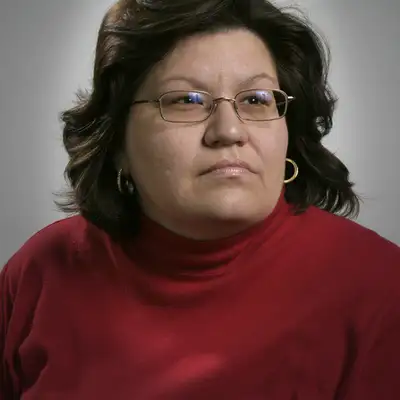
Host
Lisa VanEvery
Lisa has worked for Aboriginal Legal Services for sixteen years. She began hosting the Road To Your Name Podcast in December 2020.